



Browse Our Latest Articles From Category: AI Agents and Stay Up to Date with new thing

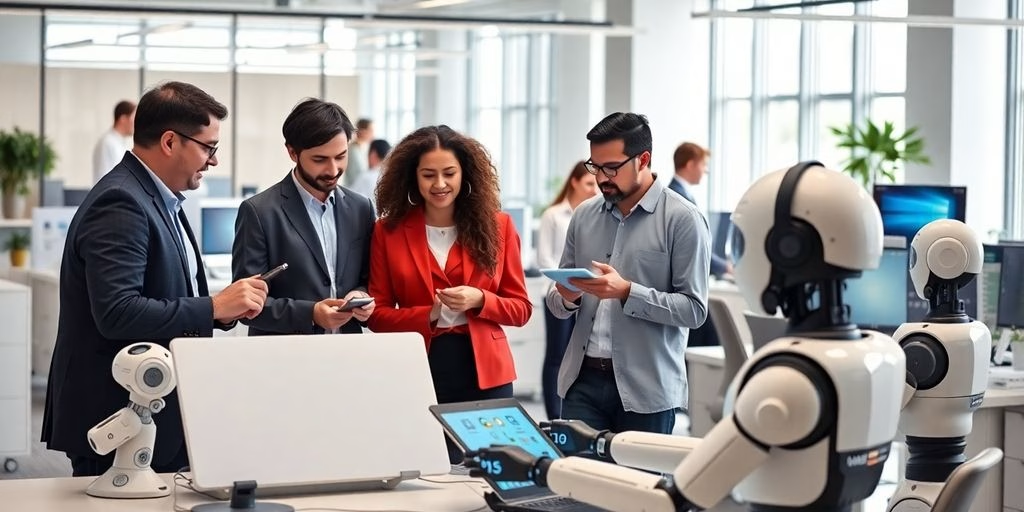
Professionals collaborating with AI agents in a modern office.
AI Agents
andre

Revolutionizing Work: The Rise of AI Agents in the Workplace

Microsoft has unveiled a groundbreaking expansion of its AI tools with the launch of new AI agents designed to transform workplace productivity. This initiative, part of the Microsoft 365 Copilot Wave 2 Spring release, aims to integrate AI as a collaborative partner in daily tasks, potentially reshaping the future of work.   Key Takeaways Microsoft introduces AI agents, Researcher and Analyst, to assist in complex tasks. The company reports a significant productivity gap, with many workers feeling overwhelmed. AI adoption is shifting from employee-led to a more strategic, top-down approach. Organizations are expected to restructure around AI capabilities, creating new roles and workflows.   The New AI Agents: Researcher and Analyst At the heart of Microsoft’s new offering are two AI agents: Researcher and Analyst. These agents leverage advanced reasoning models to perform tasks that typically require specialized human skills. Researcher: Assists in gathering and synthesizing information for reports and presentations. Analyst: Focuses on data analysis, helping teams make informed decisions based on complex datasets. Aparna Chennapragada, Chief Product Officer at Microsoft, emphasized that these agents act like “smart colleagues” who can enhance productivity by connecting disparate information sources and providing actionable insights.   Addressing Workplace Challenges Microsoft’s research highlights a pressing issue in modern workplaces: the “Capacity Gap.” Key findings include: 53% of leaders believe productivity must increase. 80% of workers report feeling they lack the time or energy to complete their tasks. Employees face an average of 275 interruptions daily, equating to one every two minutes. Chennapragada noted that AI agents could help bridge this gap by augmenting human capabilities rather than replacing jobs. This perspective aligns with the company’s vision of a future where employees manage AI agents to enhance their work output.   The Shift in AI Adoption The landscape of AI adoption is evolving. Previously, the trend was largely driven by employees seeking tools to improve their workflows. However, recent data indicates a shift towards a more strategic, top-down approach: 81% of business leaders are rethinking their core strategies with AI in mind. Leaders are more familiar with AI agents than employees, with 67% of leaders aware compared to 40% of the workforce. This change suggests that organizations are beginning to recognize the potential of AI to transform operations fundamentally.   The Future of Work: Human-Agent Collaboration Microsoft envisions a future where workplaces are structured around what they call “Work Charts,” which prioritize fluid, outcome-driven team dynamics powered by AI agents. This new model will require organizations to determine the optimal balance of human and AI collaboration, known as the “human-agent ratio.” Agent Boss: Every employee is expected to become an “agent boss,” managing AI tools to maximize productivity. New Roles: As AI becomes more integrated, companies will likely create new positions focused on AI management, such as AI trainers and data specialists.   Conclusion As Microsoft prepares to roll out these AI tools, the implications for the workforce are profound. The integration of AI agents into daily operations promises to not only enhance productivity but also redefine the roles and responsibilities of employees in the workplace. The future of work is here, and it is powered by AI.   Sources Microsoft just launched powerful AI ‘agents’ that could completely transform your workday — and challenge Google’s workplace dominance, VentureBeat. An Entire Company Was Staffed With AI Agents and You’ll Never Guess What Happened, Futurism.


Read More »
Futuristic AI agents in a digital commerce environment.
AI Agents
andre

Revolutionizing Commerce: Visa’s Vision for AI Agents

Visa recently unveiled its groundbreaking initiative, Visa Intelligent Commerce, at the Visa Global Product Drop event in San Francisco. This innovative platform aims to integrate artificial intelligence into online shopping, allowing AI agents to find, select, and purchase items on behalf of consumers, fundamentally transforming the e-commerce landscape.   Key Takeaways AI-Ready Cards: Visa is enabling bank cards to be AI-compatible, allowing AI agents to make purchases within set budgets. Tokenization for Security: Personal data will be protected through tokenization, ensuring that AI agents only access necessary spending information. Consumer Control: Users maintain control over their spending limits and can approve transactions initiated by AI agents. Partnerships with AI Leaders: Visa is collaborating with top AI companies like OpenAI and Microsoft to enhance the capabilities of its platform.   The Future of Shopping Visa’s Intelligent Commerce is set to revolutionize how consumers shop online. By leveraging AI, Visa aims to streamline the shopping experience, making it more personalized and efficient. Consumers will soon be able to delegate their shopping tasks to AI agents, which will browse, select, and purchase items based on individual preferences. Jack Forestell, Visa’s Chief Product and Strategy Officer, emphasized the importance of trust in this new era of commerce. He stated, “These agents will need to be trusted with payments, not only by users but by banks and sellers as well.”   How It Works The Visa Intelligent Commerce platform will feature several key components: AI-Ready Cards: These cards will replace traditional card details with tokenized digital credentials, enhancing security and simplifying the payment process. Personalized Shopping: Consumers can share their spending insights with AI agents, allowing for tailored shopping recommendations that align with their preferences. Spending Limits: Users can set specific spending limits and conditions for their AI agents, ensuring that they remain in control of their finances.   Collaborations and Innovations Visa is not working alone in this venture. The company has partnered with several leading AI firms, including Anthropic, IBM, Microsoft, and Samsung, to develop and implement this technology. These collaborations aim to create a seamless and secure AI-driven shopping experience for consumers.   Implications for E-Commerce The introduction of AI agents in commerce raises several questions about the future of online shopping. For instance, how will traditional advertising adapt to a landscape where AI agents make purchasing decisions? Additionally, the criteria by which AI agents select merchants and products will need to be transparent to ensure fair competition. As Visa prepares to open its API to developers later this year, the potential for innovation in AI-driven commerce is vast. With 4.8 billion Visa cards in circulation, the integration of AI into everyday shopping could lead to significant changes in consumer behavior and transaction volumes.   Conclusion Visa’s Intelligent Commerce initiative marks a significant step towards a future where AI plays a central role in e-commerce. By prioritizing security, personalization, and consumer control, Visa aims to set a new standard for online shopping. As this technology develops, it will be fascinating to see how it reshapes the retail landscape and influences consumer habits.   Sources AI agents will plan your life. And pay for it. With your money. Visa is driving a revolution in online commerce. What can we expect?, dev.ua. Find and Buy with AI: Visa Unveils New Era of Commerce, Business Wire. Retail technology innovation of the week Visa Intelligent Commerce lets AI agents find, shop and buy — Retail Technology Innovation Hub, Retail Technology Innovation Hub.

Read More »
AI agent collaborating with human workers in modern office.
AI Agents
andre

Revolutionizing Work: The Rise of AI Agents in the Workplace

In a recent press conference, Microsoft unveiled its findings on the transformative role of AI agents in the workplace, predicting significant changes in organizational structures and employee roles. The rise of ai agents in the workplace and general public will transform our world. The insights, drawn from the 2025 Work Trend Index, highlight how AI is evolving from a mere tool to a collaborative team member, reshaping the future of work.   Key Takeaways AI agents are becoming integral team members, enhancing collaboration with human employees. Companies are restructuring to facilitate teamwork between humans and AI. A new leadership role, termed ‘agent boss,’ is emerging to manage hybrid teams. The demand for AI literacy and management roles is increasing across industries.   The Emergence of AI Agents According to Microsoft’s survey of 31,000 employees across 31 countries, AI is no longer just a support tool but is now seen as a vital collaborator in various business processes. This shift is leading to the rise of what Microsoft calls “frontier companies,” which leverage AI to drive efficiency and innovation. Notable examples include: Bayer: Integrating AI in product development, saving employees six hours weekly. Dow Chemical: Utilizing AI in delivery operations, anticipating millions in cost savings. Wells Fargo: Implementing AI in customer service, reducing information retrieval time from 10 minutes to just 30 seconds.   Redefining Organizational Structures As AI agents become more prevalent, Microsoft predicts a significant shift in how organizations are structured. Key changes include: Hybrid Teams: 28% of managers plan to hire individuals to oversee teams that include both human employees and AI agents. New Leadership Roles: The concept of the ‘agent boss’ is emerging, where leaders will manage teams that consist of both AI and human members. Project-Based Organization: Companies may reorganize around specific goals rather than traditional functions like finance or marketing.   The Future of Work and AI The integration of AI into the workplace is not without challenges. A recent survey indicated that 92% of IT jobs will be transformed by AI, with many professionals fearing obsolescence. However, the demand for AI-related skills is on the rise, with companies actively seeking: AI Trainers: To educate staff on AI tools and applications. Agent Developers: To create and maintain AI systems. Data Analysis Experts: To interpret data generated by AI systems.   The Importance of AI Literacy As organizations adapt to these changes, AI literacy is becoming crucial. Employees will need to understand how to effectively delegate tasks to AI and leverage its capabilities. Skills that remain irreplaceable by machines, such as conflict resolution, adaptability, and innovative thinking, will be in higher demand.   Conclusion The future of work is being reshaped by AI agents, prompting organizations to rethink their structures and employee roles. As companies transition to hybrid teams and embrace new leadership models, the focus will increasingly be on integrating AI into the workforce in a way that enhances productivity and fosters collaboration. The journey towards this new era of work is just beginning, and organizations that adapt quickly will likely lead the way in innovation and efficiency.   Sources Microsoft sees AI agents shaking up org charts, eliminating traditional functions, CIO.

Read More »

© 2022 Cerberus Works