Shopify vs Marketplace in Indonesia: Which Should You Choose?
Indonesian sellers should start on a marketplace like Tokopedia or Shopee to validate their product and build initial sales, then add a Shopify store once monthly revenue exceeds IDR 50 million. Marketplaces provide immediate audience access; Shopify provides customer data ownership, higher long-term margins, and full brand control. The strongest Indonesian brands use both together.
Key Takeaways
- Marketplace platforms (Tokopedia, Shopee, Lazada) charge commission fees of 2–10% per transaction — on a Shopify store, that margin stays with you
- Shopify gives you complete customer data ownership — marketplaces keep all buyer data and use it to serve your competitors’ ads to your customers
- A certified Shopify Partner in Jakarta can have a fully configured Indonesian store live in 3–6 weeks
- Omnichannel commerce — selling on both Shopify and marketplaces simultaneously — is the approach used by Indonesia’s highest-performing direct-to-consumer brands
- The break-even point where Shopify’s total cost falls below marketplace commission typically occurs between IDR 30–50 million in monthly revenue
- Shopify Payments is not available in Indonesia — a third-party payment gateway (Midtrans, Xendit, or DOKU) is required for every Shopify store
What Is a Marketplace and What Is Shopify?
Before comparing the two, a clear definition matters — particularly because marketplace adalah is one of the most searched ecommerce terms in Indonesia, and the distinction between selling inside a platform versus owning one is not always obvious to sellers starting out.
A marketplace is a platform owned by a third party — Tokopedia, Shopee, Lazada — where multiple sellers list products in a shared environment. The platform provides the audience, the payment infrastructure, and the logistics framework. In exchange, it charges a commission on every sale, controls the buyer relationship, and owns all customer data generated through transactions on its platform.
Shopify is an ecommerce platform that lets you build and operate your own independent online store. You own the storefront, you own the customer data, and you control the entire buying experience from the first visit through to post-purchase communication. Shopify does not take a commission on sales — instead, you pay a monthly subscription and, because Shopify Payments is unavailable in Indonesia, a small transaction fee when using a third-party payment gateway. For a full breakdown of how the platform works, read our guide on what is Shopify and how it works.
The structural difference is ownership. On a marketplace, you are a tenant. On Shopify, you are the owner. Both are legitimate business strategies — but they have different economics, different capabilities, and different implications for long-term growth.

Shopify vs Marketplace: A Direct Comparison for Indonesian Sellers
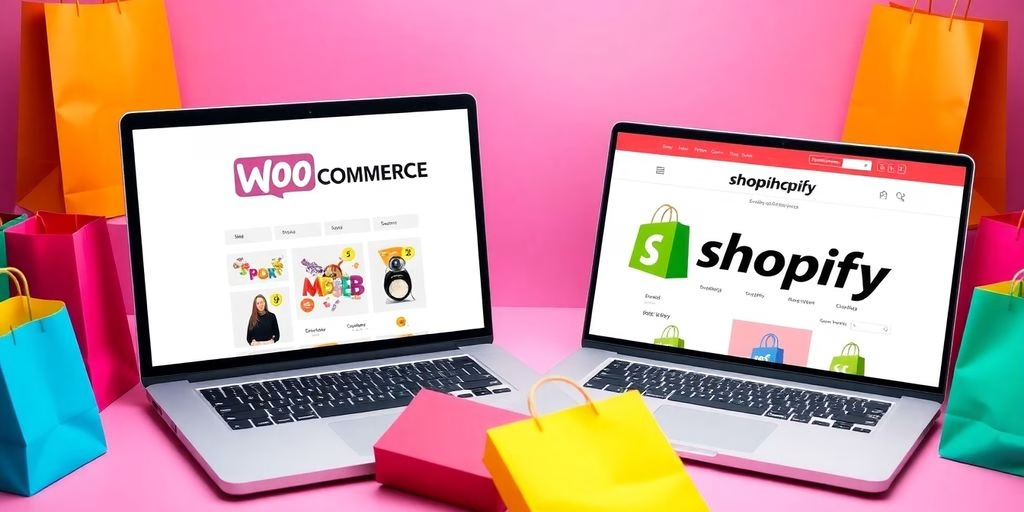
The table below compares both models across the seven factors that matter most for Indonesian sellers making a platform decision.
| Factor | Marketplace (Tokopedia / Shopee) | Shopify |
|---|---|---|
| Setup cost | Free to register | From USD 29/month (~IDR 460,000) |
| Commission fee | 2–10% per transaction | None (transaction fee 0.5–2% for 3rd-party gateway) |
| Audience | Immediate — millions of active buyers | Zero at launch — you must build or drive traffic |
| Customer data | Owned by the platform — not accessible to you | Fully owned by you — email, behaviour, purchase history |
| Brand control | Minimal — your store looks like every other store | Complete — custom design, domain, checkout experience |
| Payment methods | Handled by platform — all major Indonesian methods included | Requires Midtrans, Xendit, or DOKU integration — configurable |
| Time to first sale | 1–3 days after listing | 3–6 weeks for full build; longer to generate organic traffic |
The Commission Fee Calculation Indonesian Sellers Rarely Do
The commission fee gap between marketplaces and Shopify is the most concrete financial argument for building an owned channel — and the one most sellers have never fully calculated.
At IDR 50 million in monthly revenue, a 5% marketplace commission costs IDR 2.5 million per month. At 8%, it costs IDR 4 million. Over twelve months, that is IDR 30–48 million — enough to cover a professionally built Shopify store, twelve months of subscription, and a full payment gateway integration, with margin remaining.
Shopify’s Basic plan carries a 2% third-party transaction fee. On the Shopify plan (USD 79/month), it drops to 1%. At IDR 50 million monthly volume, the difference between a 5% marketplace commission and a 1% Shopify transaction fee is IDR 2 million every month. That money compounds — it funds inventory, marketing, or product development rather than leaving your business permanently.
Review the full cost structure on Shopify’s pricing documentation and compare against the current Tokopedia seller fee structure before making your decision — both change periodically and exact numbers should be verified at time of decision.
Customer Data Ownership: The Argument Most Sellers Miss
When you make a sale on Tokopedia or Shopee, the transaction generates a buyer profile — name, contact details, purchase history, browsing behaviour, payment preferences. That data belongs entirely to the platform. You receive an order with a shipping address. Nothing more.
This has three concrete consequences. First, you cannot build an email list from marketplace sales. You cannot send a promotional campaign to buyers who purchased from you last month. You have no mechanism for direct repeat purchase outreach. Second, the marketplace uses that buyer data to serve targeted ads — including ads for your competitors’ products — to customers who just bought from you. Third, if the marketplace changes its algorithm, raises commission rates, or removes your product category, your entire customer base disappears with it because it was never yours.
Customer data ownership on Shopify means every buyer becomes a direct relationship. You can segment customers by purchase history, trigger post-purchase email sequences, run retargeting campaigns to warm audiences, and build a loyalty programme that drives repeat revenue. According to Harvard Business Review’s research on customer retention, acquiring a new customer costs five to seven times more than retaining an existing one. Marketplaces structurally prevent retention. Shopify enables it.
Traffic: The Real Cost of Starting on Shopify
The honest counterargument to Shopify is traffic. A marketplace listing on Tokopedia or Shopee is visible to millions of active buyers from day one. A new Shopify store is invisible until you build or buy traffic — through social media, paid advertising, search engine optimisation, or WhatsApp outreach.
This is a real cost that beginning sellers systematically underestimate. Building organic traffic to a Shopify store takes three to six months of consistent content and SEO effort. Paid advertising on Meta or Google costs money before it generates return. The marketplace’s audience is not free — you pay for it through commission on every sale — but it is immediately available, which matters enormously when you are trying to validate whether your product sells at all. Google’s Core Web Vitals documentation confirms that page performance directly affects organic search ranking — meaning a well-built Shopify store earns free traffic over time in a way no marketplace listing ever can.
This is why the practical recommendation for most Indonesian sellers is sequential rather than binary: marketplace first to validate and generate early revenue, Shopify added once product-market fit is confirmed and revenue is sufficient to fund the traffic investment. For sellers who have not yet started, our guide on how to sell online in Indonesia covers the full starting framework.
Omnichannel Commerce: The Model That Wins in Indonesia
The false binary — Shopify versus marketplace — misses the model that consistently produces the best outcomes for Indonesian brands: omnichannel commerce, where both operate simultaneously with distinct roles.
In practice, the highest-performing Indonesian D2C brands use marketplaces as acquisition channels — where new customers discover them for the first time, attracted by the platform’s audience and search — and Shopify as the retention and brand channel, where returning customers buy directly, receive better loyalty benefits, and generate higher lifetime value at lower cost.
This model captures marketplace traffic without surrendering the margin and data that marketplace-only selling permanently forfeits. Shopify’s app ecosystem includes inventory sync tools that manage stock across Shopify and marketplace listings simultaneously, reducing operational complexity. A well-configured Shopify Partner implementation sets up this architecture from the start, including configuring Shopify Markets for any international expansion to Malaysia, Singapore, or Australia, avoiding the expensive retrofit that brands face when they try to add Shopify later without a structured integration. See our existing breakdown of ecommerce and marketplace differences for the full conceptual framing in Indonesian.
Which Should You Choose? A Decision Framework by Growth Stage
Indonesia’s ecommerce market is projected to exceed USD 160 billion by 2030, according to Statista’s Indonesia ecommerce forecast. The platform decision you make now determines how much of that growth your brand captures versus how much you contribute to the platform’s growth at your expense.
The right choice depends on where you are:
Under IDR 20 million/month: Start on a marketplace. Validate your product with real buyer behaviour, accumulate reviews, and learn what sells before investing in a standalone store. The commission cost at this volume is less than the risk of building a store for a product that has not yet proven market fit.
IDR 20–50 million/month: Begin planning your Shopify store. At this revenue level, the commission you are paying monthly is approaching the cost of a professional Shopify implementation. Engage a certified Shopify Partner in Jakarta for a scoping conversation — the build timeline is 3–6 weeks, which means you can have both channels running simultaneously before reaching the break-even point.
Above IDR 50 million/month: The financial case for Shopify is unambiguous. You are paying IDR 2.5–5 million monthly in commission to a platform that keeps your customer data and serves your competitors’ ads to your buyers. Building a direct channel at this revenue level recovers the implementation cost within one quarter in most product categories.
When you are ready to build, get in touch with the CWORKS team. As a certified Shopify Partner based in Jakarta, we build Indonesian stores with full local payment gateway integration, logistics setup, and post-launch support — and we help brands configure the omnichannel architecture that makes Shopify and marketplace selling work together rather than in competition.
Frequently Asked Questions
Can I sell on both Shopify and Tokopedia at the same time?
Yes — and for most scaling Indonesian brands, this is the recommended approach. Shopify’s App Store includes multi-channel inventory management tools that sync stock levels across your Shopify store and marketplace listings simultaneously, preventing overselling. The operational setup requires configuration time upfront but runs with minimal manual management once established. Using both channels lets you capture marketplace discovery traffic while building the direct customer relationships and data ownership that marketplace-only selling permanently prevents.
Does Shopify work in Indonesia without Shopify Payments?
Yes. Shopify Payments is not available in Indonesia, but this does not limit functionality — it simply means Indonesian merchants must integrate a third-party payment gateway. Midtrans, Xendit, and DOKU are the three most widely used options, all supporting GoPay, OVO, DANA, virtual bank account transfers (BCA, Mandiri, BNI, BRI), and convenience store payments. For sellers also operating offline, Bank Indonesia’s QRIS standard unifies QR payment acceptance across all e-wallet providers with a single code. Each connects to Shopify via a verified App Store integration. The configuration requires deliberate setup — payment methods must be explicitly enabled — but a properly configured Indonesian Shopify store accepts every payment method Indonesian buyers expect.
How much does it cost to switch from a marketplace to Shopify?
Switching does not mean abandoning your marketplace presence — the omnichannel model runs both simultaneously. The costs of adding Shopify to an existing marketplace operation are: platform subscription (from USD 29/month), payment gateway setup and transaction fees (varies by provider and volume), a professional build from a Shopify Partner if you want a properly configured store rather than a self-built one (IDR 15–50 million depending on catalogue complexity), and an ongoing traffic investment through organic content or paid advertising. The commission you stop paying to the marketplace on direct sales typically covers these costs within two to three months at IDR 50 million monthly revenue.
Is Shopify better than Tokopedia for Indonesian sellers?
They are not directly comparable — they solve different problems. Tokopedia provides immediate access to millions of buyers with no upfront traffic investment, at the cost of commission fees and customer data. Shopify provides complete brand control, customer data ownership, and higher long-term margin, at the cost of building your own audience. “Better” depends on your growth stage and strategic priorities. For a new seller validating a product, Tokopedia wins on speed and risk. For an established brand building long-term customer equity, Shopify wins on economics and strategic control. The strongest Indonesian brands treat this as a “both” decision, not an “either/or” one.
The Shopify versus marketplace decision is not a one-time binary — it is a question that deserves a different answer at each stage of your business. Marketplace first, to validate and build. Shopify added at scale, to own the customer relationship and recover the margin you have been paying in commission. Both together, to capture acquisition traffic and retention value simultaneously.
CWORKS is a certified Shopify Partner based in Jakarta. If you are at the stage where building a direct channel makes financial sense — or if you want to run the numbers for your specific revenue level and product category — start with a free consultation and we will give you an honest assessment of where Shopify fits in your growth plan.





![A Comprehensive Guide to Google Play Console Pricing [n8n]](https://cworks.id/wp-content/uploads/2025/09/cover-image-24622.avif)
![Understanding the Google Play Console Price: What Developers Need to Know [arvow]](https://cworks.id/wp-content/uploads/2025/05/4755037cthumbnail.avif)
















































 EN
EN  ID
ID