
Online Store Services in Indonesia: What to Expect and How to Choose the Right Partner
Online store services in Indonesia cover the end-to-end process of building a professional ecommerce website — from platform selection and design through to payment gateway integration, logistics setup, and post-launch support. Costs vary by scope and provider. A certified Shopify Partner based in Jakarta delivers a production-ready store in 3–6 weeks.
Key Takeaways
- Ecommerce website development in Indonesia typically covers design, platform setup, product catalogue migration, payment integration, and launch — not just coding
- Shopify is the most widely used platform for professional online store builds in Indonesia due to its local app ecosystem and scalability
- Payment gateway integration (Midtrans, Xendit, or DOKU) is a mandatory component — without it, Indonesian customers cannot complete a purchase
- A certified Shopify Partner in Jakarta has direct access to platform support channels and a verified track record of live store builds
- Conversion rate optimisation (CRO) should be built into the brief — not treated as an afterthought after launch
- Freelance marketplaces and specialist agencies are structurally different; for revenue-critical builds, the distinction matters
What Online Store Services in Indonesia Actually Include
Most Indonesian businesses searching for online store services have a clear end goal — a working store that takes orders, processes payments, and represents the brand professionally. What is less clear is what the service actually involves from the provider’s side, and why scope gaps between providers lead to such wildly different outcomes.
A complete ecommerce website development engagement covers six core components. Understanding each one helps you evaluate any quote or proposal accurately.
1. Platform Selection and Configuration
The first decision any reputable online store service should make with you — not for you — is which platform to build on. For Indonesian brands with growth ambitions, Shopify is the dominant choice. It handles hosting, security, and software updates natively, integrates with Indonesia’s local payment and logistics ecosystem via its App Store, and scales from a first product launch to enterprise-level volume without a platform migration.
Platform configuration goes beyond installation. Tax settings, currency display, inventory tracking rules, multi-language setup for Indonesian and English, and shipping zone configuration all need to be set correctly before a single product is listed. These settings are invisible to customers but have direct consequences on order accuracy, fulfilment speed, and accounting integrity. If you want to understand the full capabilities of the platform before committing, read our guide on what Shopify is and how it works.
2. Design and User Experience
Design is where most Indonesian online store projects are either won or lost. A theme selection made purely on visual appeal — without considering mobile load speed, checkout flow, and product discovery — consistently underperforms against a less visually striking theme configured by someone who understands conversion rate optimisation (CRO).
For Indonesian buyers specifically, mobile experience is the primary battleground. Over 70% of ecommerce browsing in Indonesia happens on a smartphone. A store that looks impressive on desktop and breaks on mobile is not a complete deliverable — it is a liability. Any online store service worth engaging will present mobile preview as a standard part of design sign-off, not an optional extra.
3. Payment Gateway Integration
This is the component most often underestimated by buyers and most often executed poorly by generalist developers. Payment gateway integration on a Shopify store in Indonesia requires configuring a third-party processor — Midtrans, Xendit, or DOKU — because Shopify Payments is not available locally.
Correct integration is not simply connecting an account. It involves configuring the right payment methods at checkout (GoPay, OVO, DANA, virtual account transfers, credit cards, convenience store payments), setting transaction fee handling, testing each payment method end-to-end before launch, and ensuring reconciliation works correctly with your accounting workflow. A store that accepts payment only via credit card in a market where the majority of buyers prefer e-wallets and virtual accounts will haemorrhage conversion from day one.
Refer to the Midtrans integration documentation for a full breakdown of supported payment methods and technical requirements.
4. Product Catalogue Setup
For brands with existing product lines, catalogue migration is labour-intensive and error-prone when done manually. Professional online store services handle structured data import — product titles, descriptions, variants, SKUs, images, and inventory counts — with quality checks at each stage. This is the unglamorous work that determines whether your store operates cleanly on day one or spends its first month correcting order errors caused by misconfigured variants.
5. Logistics and Fulfilment Integration
Indonesian brands need their online store connected to at least one courier service from launch. JNE, J&T Express, SiCepat, AnterAja, and GoSend are the most commonly integrated carriers. Professional providers configure automated shipping rate calculation based on product weight and destination zone, so buyers see accurate shipping costs at checkout rather than a flat fee that either overcharges customers or erodes your margin.
6. Post-Launch Support
A store launched is not a store operating. The first 30 days after launch consistently surface configuration issues, payment edge cases, and operational questions that no brief fully anticipates. A professional online store service includes a defined post-launch support period — typically 30 days — covering bug fixes, staff training on the Shopify admin, and minor configuration adjustments. Providers who disappear at handover are a recurring problem in the Indonesian market.
How to Choose the Right Online Store Service Provider in Indonesia
The Indonesian market for online store services spans a wide spectrum — from solo freelancers on marketplace platforms charging IDR 500,000 for a template installation, to specialist ecommerce agencies with a verified portfolio of production stores. The difference in output quality is not marginal. It is categorical.

Freelance Marketplace vs. Specialist Agency
Freelance marketplaces aggregate individual developers at competitive prices. For simple informational websites, this works. For a revenue-critical ecommerce build — where payment gateway misconfiguration directly translates to lost orders, and where post-launch support is not optional — the structural limitations of the freelance marketplace model consistently produce inferior outcomes.
The core issue is accountability. A freelance marketplace provider’s obligation ends at delivery. A specialist agency with a named client portfolio and ongoing service relationships has reputational and commercial reasons to ensure your store actually performs after launch.
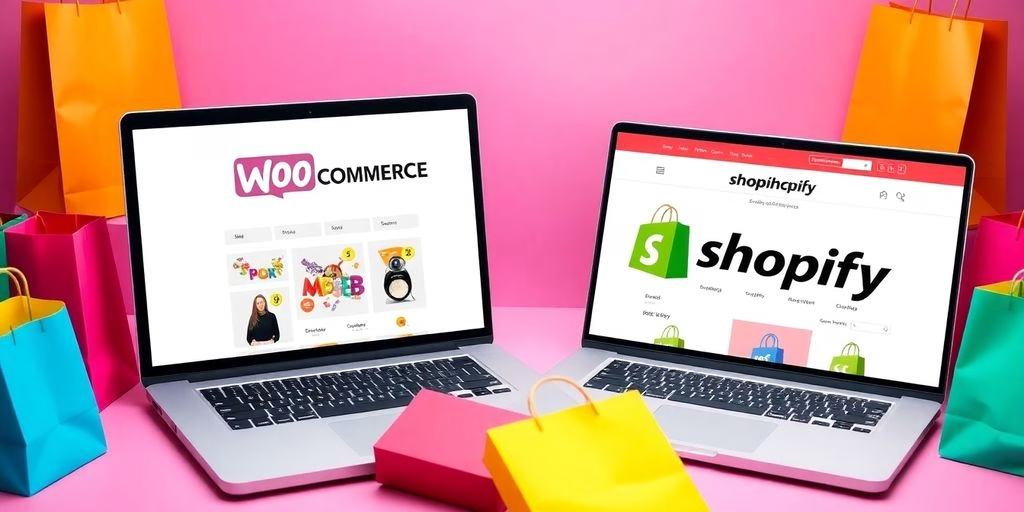
| Criteria | Freelance Marketplace | Specialist Agency (Shopify Partner) |
|---|---|---|
| Platform certification | Unverified | Shopify Partner — verified by Shopify Inc. |
| Payment gateway setup | Often basic or incomplete | Full Indonesian payment method configuration |
| Post-launch support | Typically none | Defined support period included |
| Portfolio verification | Screenshots only | Live stores with verifiable traffic and sales |
| CRO consideration | Rarely included | Built into design and UX process |
| Typical delivery time | 1–2 weeks | 3–6 weeks (full build) |
What to Ask Any Provider Before Signing
Three questions cut through most of the noise when evaluating online store services in Indonesia. First: can you share live stores you have built, with the client’s permission to verify? Screenshots are not evidence of quality. A live store that takes orders, processes payments, and loads in under three seconds on mobile is. Second: which payment gateways have you integrated on Shopify, and can you walk me through how the checkout flow works end-to-end? A provider who cannot answer this fluently has likely never built for the Indonesian market properly. Third: what does your post-launch support process look like, and what is included?
A certified Shopify Partner has cleared Shopify Inc.’s vetting process and maintains access to development tools and support channels that standard developers do not. The Shopify Partner Program lists certified partners and outlines the requirements for certification. Verifying Partner status before engaging takes thirty seconds and eliminates a significant category of risk. Browse our ecommerce website portfolio to see CWORKS’s completed Shopify builds for Indonesian brands.
Why Getting the Build Right the First Time Matters for Indonesian Brands
Indonesia’s ecommerce market generated USD 62 billion in gross merchandise value in 2023 and is projected to reach USD 160 billion by 2030, according to Statista’s Indonesia ecommerce data. That growth curve creates a false sense of safety — the assumption that rising market tide compensates for a poorly built store. It does not. Competition for direct-channel customers in Indonesia is intensifying precisely because the prize is growing.
According to Google’s Core Web Vitals guidelines, page experience signals — load speed, visual stability, interactivity — are direct ranking factors in Google Search. A Shopify store built without performance optimisation will rank below a competitor’s better-built store regardless of product quality or marketing spend. The technical foundation of your online store is not separable from your marketing performance.
As Shopify’s own merchant research consistently shows, brands that invest in a properly built direct channel — with correct checkout configuration, a clean mobile experience, and local payment methods surfaced prominently — outperform brands selling exclusively through marketplaces on revenue per customer over time. The margin recaptured from removing marketplace commission (typically 3–10% per transaction) funds the agency engagement within the first quarter for most brands at meaningful transaction volume.
In Jakarta specifically, the concentration of digital-first consumer brands, fashion labels, and F&B businesses means the bar for online store quality is rising faster than in secondary cities. A store that would have been considered professional in 2021 reads as dated in 2026. Working with a specialist who tracks platform updates, checkout best practices, and local consumer behaviour is not a premium — it is the baseline for a store that competes.
Frequently Asked Questions
How much do online store services cost in Indonesia?
Pricing varies significantly by scope and provider type. A freelance marketplace build for a basic Shopify store typically ranges from IDR 2–8 million. A full-service build from a specialist agency — covering design, complete payment gateway integration, catalogue setup, logistics configuration, and post-launch support — typically ranges from IDR 15–50 million depending on catalogue size and custom feature requirements. Shopify Plus implementations for enterprise clients start higher. The cheapest option and the most cost-effective option are rarely the same thing for a revenue-generating store.
How long does it take to build an online store in Indonesia?
A realistic timeline for a professionally built Shopify store with full Indonesian payment gateway integration, mobile-optimised design, and catalogue setup is 3–6 weeks from brief sign-off to launch. Timelines compress when product data is clean and decisions are made quickly. They extend when catalogue data is incomplete, design revisions are multiple rounds, or payment gateway account approvals are delayed — gateway approval from providers like Midtrans or Xendit requires a business document submission that can take 5–10 working days.
Which platform is best for an online store in Indonesia — Shopify or custom development?
For the majority of Indonesian brands, Shopify is the correct choice. It handles hosting, security, and updates natively, integrates with Indonesia’s payment and logistics ecosystem via its App Store, and scales to high transaction volumes without requiring a rebuild. Custom development makes sense for brands with genuinely unique technical requirements that no existing platform accommodates — a rare scenario. Custom builds are slower to launch, more expensive to maintain, and more vulnerable to developer dependency. The operational overhead of a custom store is consistently underestimated during the buying decision.
Can I migrate my existing Tokopedia or Shopee store to Shopify?
Yes. Migrating from a marketplace to a Shopify store is one of the most common briefs CWORKS handles for Indonesian brands. The process involves exporting product data from the marketplace, cleaning and restructuring it for Shopify’s catalogue format, configuring the store, and setting up the marketing infrastructure needed to drive direct traffic — since the marketplace’s audience does not transfer automatically. The technical migration itself is straightforward. The commercial strategy for building a direct customer base post-migration is where most brands need the most guidance.
Building a professional online store in Indonesia is a commercial decision, not a technical one. The platform, the payment setup, the mobile experience, and the post-launch support structure all feed directly into whether your store generates revenue or generates problems. The difference between a store that converts and one that does not is almost never the product — it is the execution quality of the build.
CWORKS is a certified Shopify Partner based in Jakarta, with a track record of online store builds for Indonesian brands across retail, fashion, food and beverage, and B2B. If you are ready to build, or want a clear picture of scope and cost before committing, get a free online store consultation and we will walk you through exactly what your build involves — timeline, cost, and what to expect at every stage.





![A Comprehensive Guide to Google Play Console Pricing [n8n]](https://cworks.id/wp-content/uploads/2025/09/cover-image-24622.avif)
![Understanding the Google Play Console Price: What Developers Need to Know [arvow]](https://cworks.id/wp-content/uploads/2025/05/4755037cthumbnail.avif)





























































 EN
EN  ID
ID