
How to Sell Online in Indonesia: A Beginner’s Step-by-Step Guide
To sell online in Indonesia as a beginner, start by choosing a sales channel — either a marketplace like Tokopedia or Shopee, or your own online store on Shopify. Set up your product listings with professional photography, configure a local payment method, and drive traffic through WhatsApp Business and social media. Most sellers can begin taking orders within one week.
Key Takeaways
- Indonesia has over 60 million active ecommerce buyers — choosing the right channel from the start determines how fast you scale
- A marketplace like Tokopedia or Shopee is the fastest way to start; a standalone online store on Shopify gives you full ownership of customer data and higher margins long-term
- Product photography is the single highest-impact, lowest-cost improvement any beginner seller can make before listing
- WhatsApp Business is used by millions of Indonesian micro-sellers to handle orders, customer service, and repeat purchases — set it up on day one
- Payment setup for Indonesian buyers must include e-wallets (GoPay, OVO, DANA) and virtual bank account transfers — credit card only will cost you sales
- Digital marketing is not optional after launch — traffic does not arrive automatically on any platform
How to Sell Online in Indonesia: 6 Steps for Beginners
Selling online in Indonesia has never been more accessible — or more competitive. The market is large, growing, and genuinely reachable from a phone and a modest product idea. What separates sellers who build a real business from those who list a few products and see nothing happen is almost always execution quality at each of these six steps, not the product itself.

Step 1: Decide What You Are Selling and Who You Are Selling To
This step is consistently skipped by beginners who are eager to list and start selling. It is also the most consequential. Two questions determine almost everything that follows: what specific product are you selling, and who specifically buys it?
The Indonesian ecommerce market rewards specificity. A seller of “fashion items” competes with hundreds of thousands of listings. A seller of “oversized linen shirts for working women in their 30s” has a defined audience, can write product descriptions that speak directly to that buyer, and can target social media ads with precision. The product does not need to be unique. The positioning does.
Before listing a single item, write one sentence that identifies your buyer by age, lifestyle, and the problem your product solves. Every decision after this — platform choice, photography style, caption tone, pricing — should be consistent with that sentence.
Step 2: Choose Your Sales Channel
Indonesian online sellers have two structural choices: sell inside a marketplace, or build a standalone online store. Most beginners should start with a marketplace. Most sellers with serious growth ambitions should plan to add a standalone store within twelve months.
Marketplaces (Tokopedia, Shopee, Lazada) give you immediate access to an existing audience of buyers. Registration is free, listing is simple, and you can have a product available for purchase within a day. The trade-off is real: marketplaces take a commission on every sale (typically 2–10%), you do not own customer data, and you compete on price directly against other sellers of the same product. Register your seller account via the Tokopedia seller portal or Shopee’s equivalent to get started.
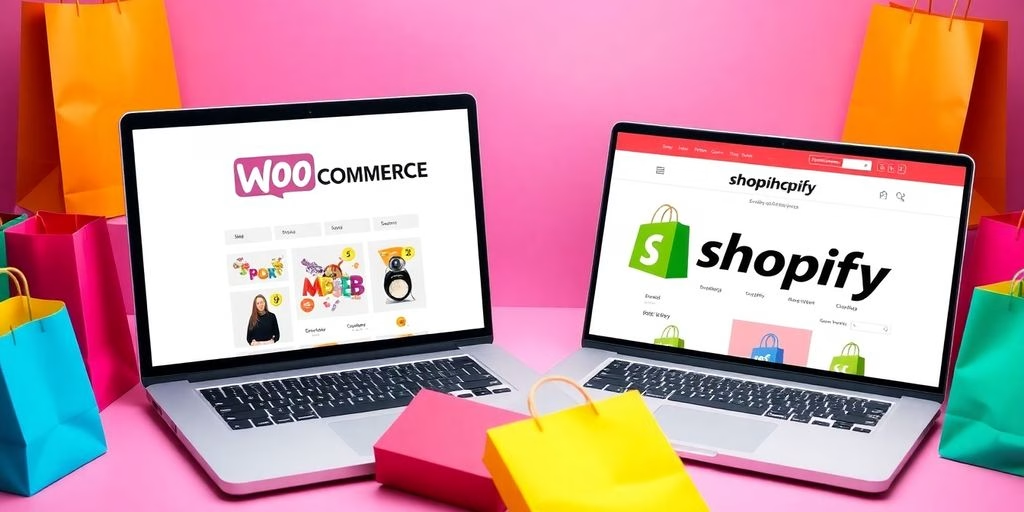
Standalone online stores require more setup but give you complete ownership — of the customer relationship, the brand experience, the data, and the margin. Shopify is the leading platform for this in Indonesia, with a local app ecosystem covering Indonesian payment gateways and logistics carriers. If you want to understand the full platform before committing, read our guide on what Shopify is and how it works. For a professional build with full payment integration, see our online store services in Indonesia.
The practical approach for most beginners: start on a marketplace to validate product-market fit with real orders, then build your Shopify store once you have confirmed what sells. Shopify’s own beginner resources at Shopify’s guide to selling online walk through the full store setup process in detail.
Step 3: Set Up WhatsApp Business on Day One
Regardless of which sales channel you choose, WhatsApp Business is a non-negotiable tool for Indonesian sellers. It functions as your customer service channel, your order confirmation system, your repeat purchase trigger, and — for many micro-sellers — the primary sales channel before a formal store or marketplace presence is established.
WhatsApp Business is free and takes under thirty minutes to configure properly. The features that matter most for sellers are the business profile (your address, operating hours, and product catalogue link), quick replies (saved responses for common questions about price, size, and shipping), and broadcast lists (for promotions sent to opted-in customers). The WhatsApp Business official documentation covers setup and all features in full.
Indonesian buyers expect WhatsApp availability. A store or listing without a WhatsApp contact point loses a meaningful portion of buyers who want to ask one question before purchasing — and would have converted if answered promptly.
Step 4: Photograph Your Products Properly
Product photography is the highest-leverage improvement available to any beginner seller, and it requires no professional equipment. A smartphone, a white or neutral background, natural daylight from a window, and thirty minutes of shooting time will produce images that outperform the majority of listings in any product category on Indonesian marketplaces.
Three image types cover the essentials for every product listing. A clean hero shot — product centred against a white background — is the thumbnail that determines whether a buyer clicks. A lifestyle shot — the product in use, in context — communicates value and aspiration. A detail shot — close-up of texture, label, or quality indicator — answers the question every buyer has before purchasing: is this actually good quality?
Google’s guidance on product image best practices applies directly to ecommerce listings: high resolution, accurate colour representation, and no watermarks are the baseline requirements that most beginner sellers violate in their first listings.
Beyond still images, short video — 15 to 30 seconds showing the product from multiple angles or in use — consistently outperforms static images in Indonesian social selling contexts. It requires no editing software. Shoot in portrait format and post directly to Instagram Reels, TikTok, and your WhatsApp Business catalogue.
Step 5: Configure Your Payment Setup for Indonesian Buyers
Payment configuration is where the gap between a store that converts and one that does not is most clearly visible. Indonesian buyers have strong preferences for specific payment methods — and a checkout that does not offer those methods will be abandoned regardless of how good the product is.
The Indonesian payment landscape is dominated by e-wallets (GoPay, OVO, DANA, ShopeePay, LinkAja), virtual bank account transfers (BCA, Mandiri, BNI, BRI), and convenience store payments (Alfamart, Indomaret). Credit card penetration remains relatively low. Bank Indonesia’s QRIS (Quick Response Code Indonesian Standard) has standardised QR payment acceptance across providers — if you sell in person or via WhatsApp, a single QRIS code accepts payment from any e-wallet app. Read the official Bank Indonesia digital payment guidelines for compliance requirements.
For marketplace sellers, payment is handled by the platform. For Shopify store owners, payment requires integrating a third-party gateway — Midtrans, Xendit, or DOKU — and configuring all relevant Indonesian payment methods at checkout. Getting this wrong on a Shopify store is one of the most common causes of abandoned carts at launch.
Step 6: Drive Traffic to Your Listings or Store
Products do not sell themselves on any platform. Marketplace listings need optimised titles, the right category tags, and either paid promotion within the platform or enough organic reviews to surface in search results. Standalone stores need an active traffic strategy from day one — organic social, paid ads, WhatsApp broadcast, or search engine content.
For beginners, Instagram and Facebook remain the highest-return starting channels for Indonesian consumer products. Meta Business Suite manages both platforms from one dashboard, allows you to create shoppable posts linked directly to your product listings, and provides audience targeting tools that let you reach buyers by location, age, interest, and behaviour — all relevant for defining the specific buyer you identified in Step 1.
TikTok has become an increasingly important channel for Indonesian consumer brands, particularly in fashion, food, and lifestyle categories. Short-form video content that shows the product in use, or tells the story behind the brand, consistently outperforms static ad creative on the platform. Organic reach is still achievable for accounts that post consistently and engage with the format natively.
For sellers looking to build digital marketing skills systematically, Google Digital Garage offers free certification courses covering search, social, and content marketing — all applicable to the Indonesian market. For brands ready to invest in professional digital marketing support, see our digital marketing services.
Why Most Indonesian Beginners Struggle to Scale Past Their First 100 Orders
Indonesia’s ecommerce market had over 196 million online shoppers in 2024, a figure projected to reach 230 million by 2027, according to Statista’s Indonesia ecommerce data. The market size is not the obstacle. The obstacle is almost always a structural problem in how the seller’s operation is set up — one that becomes visible at scale and invisible at single-digit order volumes.
The most common structural problem is channel dependency. A seller who builds entirely on Shopee has no customer data when Shopee changes its algorithm, raises commission rates, or a competitor undercuts their price by 5%. Every order processed through a marketplace is revenue that builds the marketplace’s relationship with the customer — not yours. This is not an argument against marketplaces as a starting point. It is an argument for building a parallel owned channel — a Shopify store, a WhatsApp Business contact list, an email subscriber base — from as early as possible.
The second structural problem is treating traffic as someone else’s responsibility. Beginners consistently expect that listing a product on a marketplace or launching a store generates automatic visibility. It does not. Marketplace search algorithms reward sales velocity, review count, and ad spend. Google rewards content quality, site speed, and inbound links. Instagram rewards posting consistency and engagement rate. None of these reward passive presence.
As Google’s Digital Garage training emphasises, the businesses that sustain ecommerce growth are those that treat customer acquisition as a skill to be developed, not a cost to be minimised. The sellers who progress past 100 orders are those who have a repeatable process for bringing new customers in — and a system for bringing existing customers back.
The third structural problem is underinvestment in brand. Indonesian ecommerce buyers have more choices than ever. Price alone does not retain customers — it attracts price shoppers, who leave the moment a cheaper option appears. A recognisable brand identity, consistent visual presentation across channels, and a clear value proposition beyond price are what convert first-time buyers into repeat customers. This is where professional product photography, consistent design, and a coherent brand voice pay compounding returns over time.
Frequently Asked Questions
Do I need a business licence to sell online in Indonesia?
For casual individual sellers, no formal business licence is required to start selling on Indonesian marketplaces. However, if you are operating as a business entity, processing significant transaction volumes, or selling regulated product categories (food, cosmetics, health products), compliance with Indonesian business registration requirements and relevant product regulations applies. For brands building a Shopify store with intent to scale, registering as a PT (Perseroan Terbatas) or CV provides legal protection and enables proper tax compliance. Consult a local business consultant or notary for the current registration process.
Is it better to start on Tokopedia or Shopee in Indonesia?
Both platforms are viable starting points — the better choice depends on your product category and target buyer. Shopee skews younger, has stronger mobile app engagement, and tends to perform better for fashion, beauty, and lifestyle products. Tokopedia has a broader demographic reach and stronger presence in electronics, home goods, and B2C service categories. Many successful Indonesian sellers operate on both simultaneously, managing inventory from a single dashboard via a multi-channel management app. Starting on one, learning the algorithm, and expanding to the other within 60–90 days is a practical approach.
How much money do I need to start selling online in Indonesia?
Selling on a marketplace requires minimal upfront investment — seller registration is free on both Tokopedia and Shopee, and you only need product inventory and a smartphone to begin. A basic product photography setup (white cardboard background, natural light) costs under IDR 50,000. Paid promotion within the platform accelerates early visibility and typically starts from IDR 50,000 per day. Building a standalone Shopify store adds platform subscription costs (from USD 29 per month) plus payment gateway setup. Total investment to launch a credible marketplace presence with basic promotion: IDR 500,000–2,000,000 in the first month.
Can I sell online from home without a warehouse in Indonesia?
Yes — the majority of small Indonesian online sellers operate from home without dedicated warehouse space. Marketplaces handle payment processing and provide shipping labels; you pack and hand over to the courier. For Shopify store owners, courier integrations with JNE, J&T, SiCepat, and GoSend allow home pickup scheduling directly through the store’s fulfilment dashboard. As order volume grows beyond what home storage practically supports — typically 30–50 orders per day — third-party fulfilment services that warehouse, pack, and ship on your behalf become cost-effective alternatives to renting commercial space.
Selling online in Indonesia is genuinely accessible for beginners. The platforms exist, the buyers are there, and the tools to build a real business from a phone and a product are available at minimal cost. What determines outcome is not access — it is the quality of execution at each step, and the decision about when to move from marketplace dependency to an owned channel that builds lasting commercial value.
When you are ready to build a standalone online store — or want an honest assessment of what your next step should be — start with a free consultation with the CWORKS team. We work with Indonesian brands at every stage, from first store launch to enterprise-level Shopify implementations.





![A Comprehensive Guide to Google Play Console Pricing [n8n]](https://cworks.id/wp-content/uploads/2025/09/cover-image-24622.avif)
![Understanding the Google Play Console Price: What Developers Need to Know [arvow]](https://cworks.id/wp-content/uploads/2025/05/4755037cthumbnail.avif)
















































 EN
EN  ID
ID